

By Dr. Abdullatif Alfadhel Alshanqiti
Associate Editor
The Moment Sound Returned
For many people, hearing is an invisible part of daily life.
It is present in every conversation, every expression of emotion, every warning signal, and every connection between human beings. Its importance is often recognized only after it begins to disappear.
For a 56-year-old man in Saudi Arabia, silence had gradually become his reality.
The voices of family members became increasingly distant. Conversations became difficult to follow. Everyday sounds that most people experience without thought—the movement of the surrounding world, the voices of loved ones, the call to prayer, and the subtle signals that provide orientation and safety—faded beyond reach.
Yet his experience was not complete silence.
Alongside his profound hearing loss was persistent tinnitus, a condition in which individuals perceive sound despite the absence of an external source. For some patients, tinnitus appears as ringing, buzzing, or hissing, creating a challenging paradox: a world without meaningful external sound but with an exhausting internal noise.
Clinical evaluation revealed a severe auditory disability: profound bilateral sensorineural hearing loss with no functional speech recognition. Conventional amplification could no longer provide meaningful benefit because the damaged sensory structures of the inner ear were unable to convert amplified sound into understandable information.
For patients in this situation, the challenge is not simply hearing volume.
It is access to communication itself
A Surgical Achievement Beyond the Operating Room
At King Abdullah Medical City (KAMC) in Makkah, this patient became part of a remarkable intersection between advanced otologic surgery, biomedical innovation, and multidisciplinary expertise.
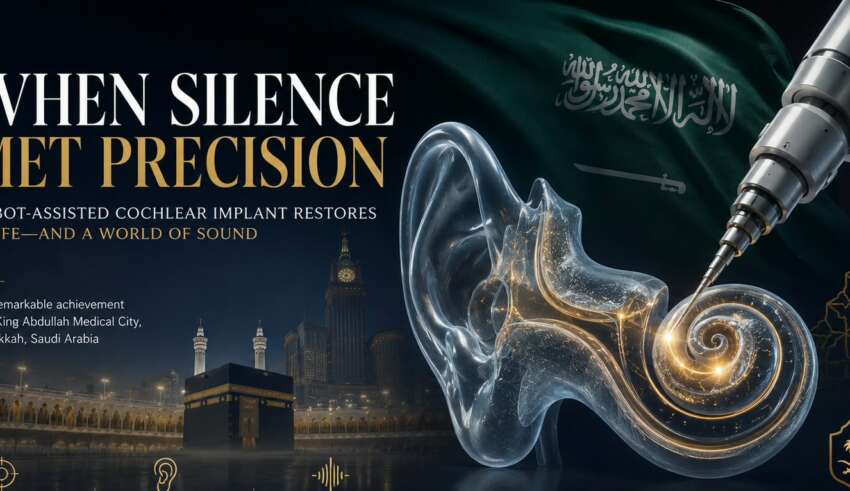
The medical team successfully performed robot-assisted bilateral cochlear implantation, applying modern precision technology to a procedure designed to restore meaningful auditory function.
The achievement represents more than the successful implantation of a medical device.
It reflects the evolution of hearing restoration from traditional amplification toward sophisticated neural rehabilitation, where engineering and medicine converge to reconnect patients with the auditory world.
It also highlights the expanding capabilities of Saudi Arabia’s tertiary healthcare system, where specialized centers are increasingly adopting advanced technologies, multidisciplinary pathways, and precision-based approaches aligned with the goals of Saudi Vision 2030.
From Amplifying Sound to Restoring Auditory Access
Unlike hearing aids, which amplify sound, cochlear implants are designed for people with severe to profound sensorineural hearing loss who derive limited benefit from conventional amplification. Instead of making sounds louder, the device bypasses damaged sensory hair cells in the inner ear and directly stimulates the auditory nerve with electrical signals, allowing the brain to perceive sound through an alternative pathway.
Modern cochlear implantation is far more than a surgical procedure
It combines advanced microsurgery, audiology, and structured rehabilitation to help patients regain meaningful access to speech and environmental sounds. Although the experience differs from natural hearing, many recipients achieve substantial improvements in communication, independence, and quality of life following rehabilitation.
Inside the Cochlea: Where Millimetres Matter
Few surgical procedures demand the precision required in cochlear implantation. The cochlea—a tiny, spiral-shaped structure deep within the inner ear—contains the delicate neural pathways responsible for transmitting sound to the brain. Even minimal trauma during electrode insertion may affect surgical outcomes.
For this reason, cochlear implantation requires meticulous planning, refined microsurgical technique, and exceptional surgical precision. Robot-assisted systems are designed to support these critical steps by enhancing stability, improving trajectory planning, and promoting controlled, consistent instrument movement—while the surgeon remains fully responsible for every clinical decision.
Ultimately, the goal is not to replace surgical expertise, but to complement it in the pursuit of safer, more precise hearing restoration.
Where Robotics Meets Otologic Surgery
Robot-assisted cochlear implantation represents a new stage in the evolution of precision ear surgery.
Importantly, these systems are not designed to replace surgeons.
They function as advanced assistance technologies that support human expertise with enhanced stability, planning capability, and mechanical precision.
Potential advantages of robotic assistance include:
- improved trajectory planning,
- enhanced positional stability,
- controlled movement during delicate surgical steps,
- reduction of unintended movement,
- increased reproducibility.
Research in robotic-assisted otologic surgery continues to explore how these technologies may improve consistency and reduce surgical trauma.
However, the field remains actively developing.
The most important principle remains unchanged:
The surgeon remains responsible for clinical judgment, decision-making, and patient safety.
Robotics does not replace expertise.
It extends what expert surgeons can achieve.
Bilateral Cochlear Implantation: Restoring the Advantage of Two Ears
The decision to perform bilateral cochlear implantation carries important clinical significance.
Human hearing is naturally designed for two ears. The brain continuously compares information arriving from both sides, allowing individuals to determine where sounds originate, separate speech from background noise, and maintain awareness of their surroundings.
This ability known as binaural hearing is essential for many everyday situations.
Two implanted ears can provide potential advantages, including:
- improved speech understanding in noisy environments,
- better sound localization,
- enhanced spatial awareness,
- reduced listening effort,
- a more balanced auditory experience.
For patients with profound hearing loss affecting both ears, bilateral implantation may offer important functional benefits compared with relying on only one auditory pathway.
However, the success of cochlear implantation is not measured only inside the operating room.
The true outcome appears later in conversations, relationships, independence, and participation in daily life.
The Team Behind the Technology
A cochlear implant program is not built by surgeons alone.
Behind every successful implantation is a coordinated network of specialists working through every stage of the patient journey.
At King Abdullah Medical City, advanced otologic care depends on multidisciplinary collaboration involving:
- otolaryngology and otologic surgeons,
- audiologists,
- speech and language therapists,
- radiologists,
- anesthesiology teams,
- specialized nurses,
- rehabilitation professionals,
- biomedical and technical support teams.
Before surgery, patients undergo detailed evaluation, including audiological testing, imaging assessment, medical review, and counseling regarding expected outcomes.
After implantation, the process continues through device programming and auditory rehabilitation.
The implant provides access to sound, but the brain requires time and training to interpret electrical signals.
Patients gradually progress from detecting sounds to recognizing environmental cues, understanding speech, and reconnecting with communication.
This long-term pathway represents one of the defining principles of modern cochlear implantation:
successful hearing restoration is not only a surgical achievement—it is a comprehensive healthcare process.
King Abdullah Medical City: Building Advanced Hearing Care in Makkah
Located in Makkah, King Abdullah Medical City (KAMC) has developed as a major tertiary healthcare institution providing specialized medical services for complex conditions requiring advanced expertise and multidisciplinary management.
Within otolaryngology, the institution has expanded capabilities across several areas, including advanced otology, cochlear implantation, skull base surgery, head and neck disorders, and complex airway and surgical care.
The growth of KAMC’s cochlear implant services reflects the broader development of specialized surgical programs within Saudi Arabia.
A peer-reviewed analysis of KAMC’s cochlear implant experience evaluated 133 patients treated between 2018 and 2023, providing institutional clinical data regarding patient characteristics, surgical outcomes, and follow-up experience.
In addition, KAMC has reported that its Cochlear Implant Center has completed more than 250 cochlear implant procedures since its establishment, demonstrating the development of a mature clinical pathway serving patients requiring advanced hearing restoration.
These achievements represent more than procedural numbers
They reflect the infrastructure required to deliver modern cochlear implant care:
- specialized surgical expertise,
- advanced audiological assessment,
- rehabilitation services,
- long-term patient follow-up,
- multidisciplinary coordination.
Beyond Cochlear Implants: The Evolution of Otolaryngology at KAMC
The advancement of cochlear implantation exists within a broader transformation of otolaryngology practice.
Modern ENT medicine has evolved from treating isolated conditions of the ear, nose, and throat into a highly specialized field incorporating microsurgery, oncology, reconstruction, navigation technology, and multidisciplinary care.
At tertiary centers such as KAMC, otolaryngology services address complex conditions including:
Otology and Neurotology
Advanced management of disorders affecting:
- hearing,
- balance,
- the middle and inner ear,
- complex ear surgery,
- cochlear implantation.
Skull Base Surgery
The interface between otolaryngology, neurosurgery, radiology, and oncology has created highly specialized approaches for tumors and disorders involving the skull base.
Head and Neck Surgery
Modern treatment of head and neck conditions increasingly depends on multidisciplinary collaboration involving surgery, oncology, pathology, radiology, and reconstruction.
Rhinology and Advanced Sinus Surgery
Complex sinonasal disorders benefit from advanced imaging, endoscopic techniques, and precision surgical approaches.
Airway and Voice Disorders
Specialized ENT teams contribute to the management of complex airway conditions, swallowing disorders, and voice-related problems.
The importance of these services extends beyond individual procedures
A modern ENT department functions as an integrated system where diagnosis, surgery, rehabilitation, research, and education work together.
Technology and Saudi Arabia’s Healthcare Transformation
The development of advanced surgical programs at institutions such as KAMC reflects a wider transformation occurring across Saudi Arabia’s healthcare landscape.
Under Saudi Vision 2030, the Kingdom has prioritized:
- healthcare quality improvement,
- digital transformation,
- innovation,
- specialized medical services,
- advanced surgical technologies,
- research and medical education.
Robotic surgery, artificial intelligence, precision medicine, and advanced imaging technologies are increasingly becoming components of modern healthcare delivery.
However, technology alone does not transform healthcare.
The true measure of progress is the ability to combine technology with skilled professionals, evidence-based practice, and patient-centered care.
The robot is not the achievement by itself
The achievement is the ecosystem that allows advanced technology to improve human lives.
The Future of Robotic Otologic Surgery
Robot-assisted ear surgery remains an evolving field.
Around the world, researchers continue investigating how robotics, artificial intelligence, and digital planning may further improve surgical precision.
Future developments may include:
- improved image-guided navigation,
- artificial intelligence-assisted surgical planning,
- real-time force feedback systems,
- enhanced three-dimensional visualization,
- integration of robotic platforms with digital operating rooms.
The long-term goal is not autonomous surgery.
Rather, the objective is safer, more predictable, and more personalized surgical care.
The future of otologic surgery will likely depend on the collaboration between human expertise and technological innovation.
More Than Restoring Hearing
The success of a cochlear implant can be measured through audiological assessments, speech recognition scores, and clinical outcomes.
But some of the most meaningful outcomes cannot be fully represented by numbers.
They appear in moments:
A patient recognizing a familiar voice again.
A family conversation becoming possible.
The return of awareness to the surrounding world.
The ability to participate independently in daily life
For individuals living with profound hearing loss, restoring auditory function means more than receiving sound.
It means restoring connection.
A New Era of Hearing Restoration
The robot-assisted bilateral cochlear implantation performed at King Abdullah Medical City represents an important example of how modern medicine is evolving.
It demonstrates the convergence of:
- advanced surgical expertise,
- biomedical engineering,
- multidisciplinary teamwork,
- rehabilitation science,
- and healthcare innovation.
For one patient, the achievement marked the beginning of a return to the world of sound.
For Saudi Arabia’s healthcare system, it represents a broader journey toward building specialized centers capable of delivering complex, technology-driven medical care.
The future of hearing restoration will not be defined by machines alone
It will be defined by the clinicians, researchers, engineers, and healthcare systems that transform innovation into meaningful human outcomes.
Because ultimately, the purpose of precision medicine is not technology itself.
It is the restoration of what matters most: