

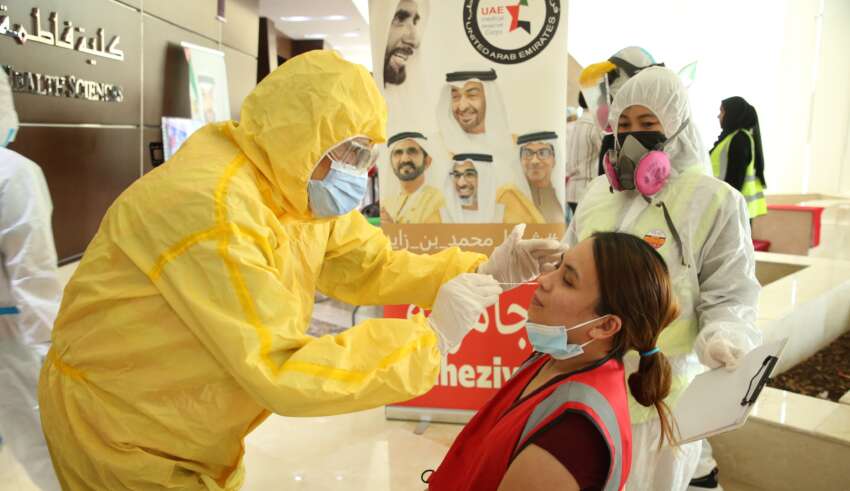
ABU DHABI: The National Readiness Forum for First Line Defenders and First Responders, themed “Together for a Ready Nation,” was launched in Abu Dhabi. The forum aims to develop skills, enhance competencies, and strengthen the preparedness of government, private, and community institutions to respond to emergencies, crises, and disasters. This initiative falls under the umbrella of the UAE Preparedness and Response Program, “Jahiziyah,” and is being held in cooperation with the National Training Center, “Tadreeb.”
The forum is part of a series of specialized programs and workshops designed to build the capabilities of first line defenders, develop the skills of first responders, and enhance institutional and community readiness through a unified training curriculum that combines theoretical lectures, practical exercises, and field simulations.
The program includes seven training hours, comprising three hours of specialized lectures and four hours of practical exercises and field simulations, conducted in environments that simulate institutions, facilities, neighborhoods, and residential complexes.
The lectures cover a number of topics related to the principles of preparedness and response, the role of the first line of defense, risk assessment and responder safety, incident site management, initial casualty assessment, command and control, emergency communication, evacuation and assembly point management, as well as institutional and community preparedness.
The practical exercises include scenarios simulating real-life incidents within institutions and residential areas. These exercises focus on incident site assessment, risk identification, activation of the emergency plan, organization of response teams, initial casualty management, evacuation execution, assembly point management, and coordination with relevant authorities.
The forum also witnessed the launch of the National Mobile Training Center, an initiative aimed at bringing specialized training and simulation to institutional and community sites, providing a flexible, field-based training environment that contributes to skills development and enhances response efficiency.
The center comprises ten specialized training modules covering command and control, multi-agency incident management, handling chemical, biological, radiological, nuclear, and explosive hazards, assessment and triage, rapid intervention and response, decontamination, evacuation and transport, as well as modules for a field hospital and simulation training. The forum also included the screening of a documentary showcasing the UAE’s achievements in building national preparedness and responding to emergencies and disasters in both the health and non-health sectors. Several leaders, trainers, and preparedness teams participating in specialized training and qualification programs within the unified and integrated national system for medical preparedness and response were also honored.
Dr
Adel Al Shamri Al Ajami, CEO of the Zayed Giving Initiative, Chairman of the Emirates Doctors Program, and CEO of the Emirates Preparedness and Response Program (Jahiziyah), stated that the UAE continues to adopt innovative initiatives that invest in developing human capital and building national capabilities. This enhances the ability of institutions and society to respond to emergencies and disasters according to a unified methodology and advanced training standards.
He added that the launch of the mobile national preparedness training center represents a qualitative leap in specialized training, as it allows for the transfer of training and simulation programs to institutions, neighborhoods, and communities, training participants in realistic environments that simulate the nature of various accidents and emergencies.
He noted that the “Readiness” programs have contributed over the past years to training and qualifying thousands of first responders from medical, ambulance, civil defense, police, security, and defense agencies, as well as emergency response teams. These programs have also developed trainers and leaders specializing in readiness and response.
For his part, Professor Roberto Megavero, President of the European Centre for Disaster Medicine, emphasized the importance of building the capacity of first responders and multi-agency, multi-disciplinary teams to enable them to operate within a unified system during emergencies and disasters.
He stated that rapid urban and economic development necessitates adopting high levels of proactive readiness and continuous investment in training, exercises, and simulations. He also pointed to the importance of standardizing training criteria for healthcare and non-healthcare personnel in response agencies.
He indicated that the European Centre for Disaster Medicine is working in cooperation with the UAE Preparedness and Response Program on a long-term plan aimed at training and qualifying 50,000 first responders both in the field and virtually. This plan also includes developing leaders and trainers across the UAE, in coordination with governmental, private, and community institutions.
The forum targets employees in government and private sectors, security, safety, and emergency teams, healthcare and ambulance personnel, civil defense, police and security agencies, occupational health and safety officers, and employees in vital facilities, schools, universities, and residential complexes, in addition to volunteers and first responders.
Participants who meet the program requirements will receive a certificate from the Readiness Academy and the European Centre for Disaster Medicine, as part of efforts to support national preparedness and build an integrated and sustainable system for emergency and disaster response.